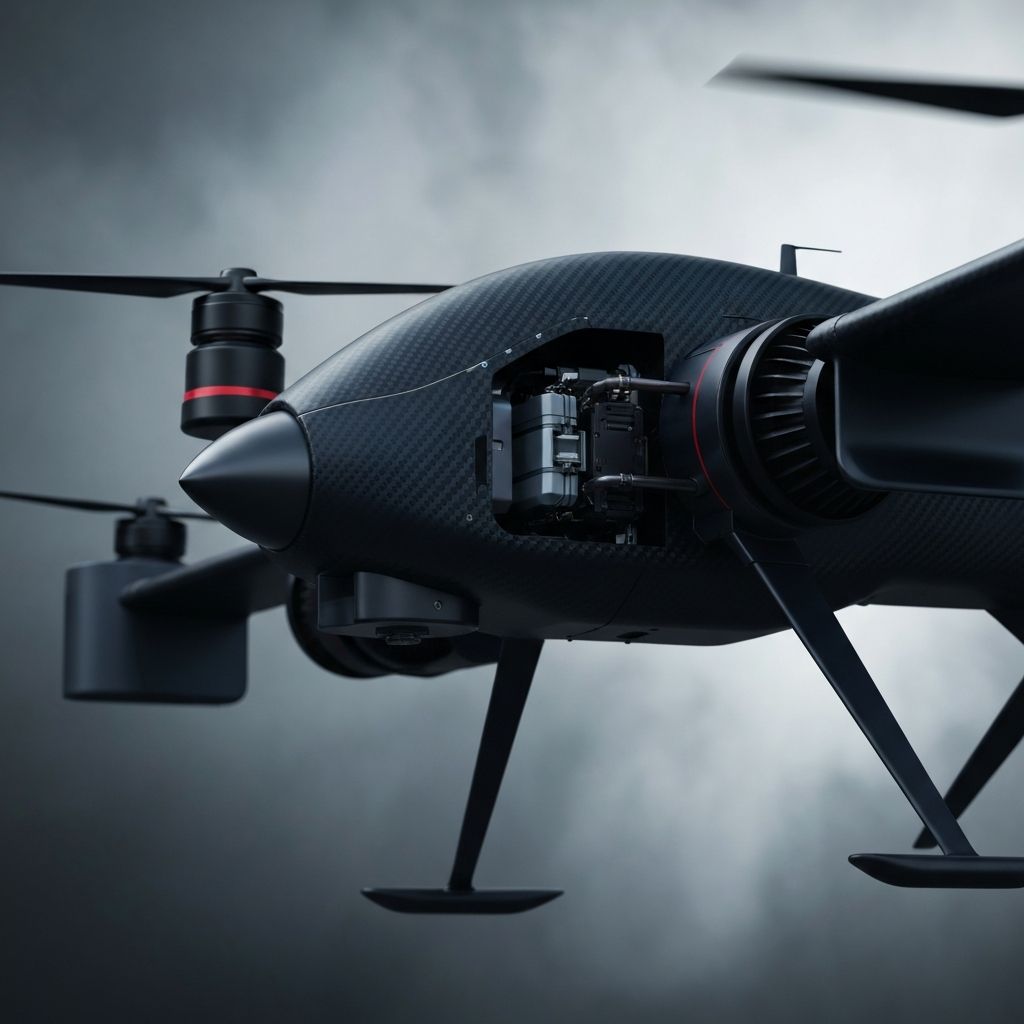
The choice of aircraft platform fundamentally shapes the capabilities of any autonomous surveillance system. For dock-deployed operations requiring both rapid response and extended endurance, hybrid VTOL (Vertical Take-Off and Landing) platforms offer compelling advantages over pure multicopter or fixed-wing alternatives.
Understanding Hybrid VTOL
Hybrid VTOL aircraft combine vertical lift rotors with fixed-wing surfaces, enabling them to take off and land vertically like a helicopter while cruising with the efficiency of an aeroplane. This configuration solves several critical challenges for autonomous surveillance operations.
The Multicopter Limitation
Traditional multicopter drones excel at vertical flight and precise hovering but suffer from severe endurance limitations. Their rotors must continuously generate lift to counter gravity, resulting in flight times typically under 45 minutes for platforms capable of carrying useful sensor payloads.
The Fixed-Wing Challenge
Conventional fixed-wing aircraft achieve dramatically better endurance by generating lift from airflow over wings rather than rotor thrust. However, they require runways or launch systems for takeoff and landing, making them impractical for remote autonomous dock operations.
VTOL Advantages for Autonomous Operations
Dock Compatibility
VTOL aircraft can take off and land on compact dock platforms without requiring runways, catapults, or recovery systems. This enables deployment in remote locations where infrastructure is minimal.
Extended Endurance
Once transitioned to forward flight, VTOL aircraft achieve endurance figures of 2-4 hours or more, depending on configuration. This extended flight time enables meaningful patrol coverage from each sortie.
Speed and Coverage
Cruising speeds of 80-120 km/h allow VTOL platforms to cover large areas efficiently. A single dock station can effectively monitor patrol zones of 50-100 square kilometres with appropriate mission planning.
Hover Capability
When targets of interest are identified, VTOL aircraft can transition to hover mode for detailed inspection, loiter, or precise sensor positioning—capabilities fixed-wing aircraft cannot match.
Technical Considerations
Transition Flight
The transition between vertical and horizontal flight modes represents the most technically demanding aspect of VTOL operations. Modern flight controllers handle this seamlessly, but platform design must account for the aerodynamic complexities of transition flight envelopes.
Power Systems
VTOL operations place unique demands on power systems. Vertical flight consumes significantly more energy than cruise flight, requiring careful battery management and sizing to ensure adequate reserves for landing.
Redundancy
Reliable autonomous operations demand redundant systems. Modern VTOL platforms incorporate redundant motors, flight controllers, and power distribution to maintain safe operation even with component failures.
The Future of VTOL
Advances in battery technology, electric motor efficiency, and autonomous flight systems continue to extend VTOL capabilities. We anticipate significant improvements in endurance and payload capacity over the coming years, further expanding the operational envelope for autonomous surveillance applications.
PERCH Autonomous Systems
Research & Development Team